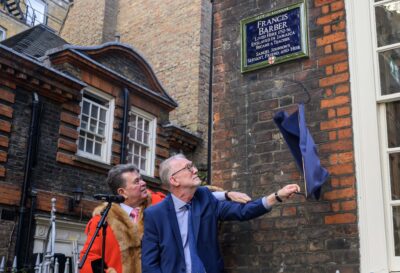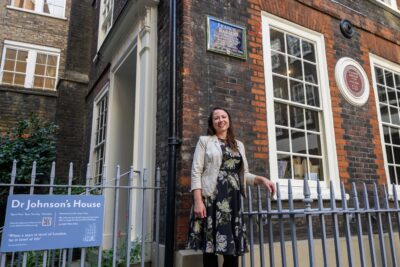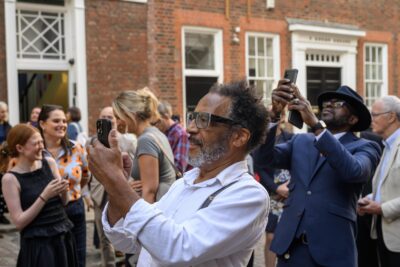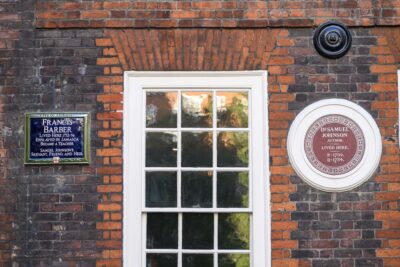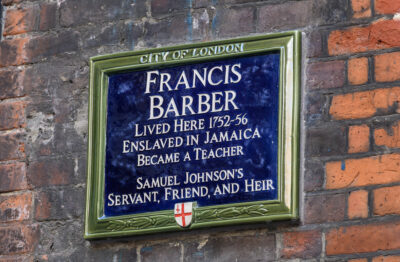
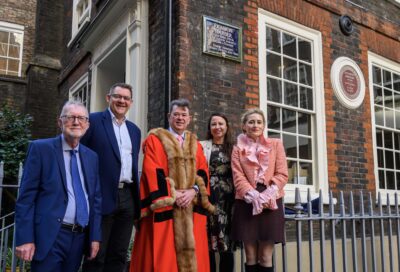
The remarkable life of Francis Barber, the servant, friend, and heir to Dr Samuel Johnson, has been commemorated during a ceremony at the writer’s townhouse on Gough Square in Fleet Street Quarter, which also marked the launch of the redesigned City of London Blue Plaques Scheme.
Barber, a West African man born into slavery in Jamaica, came to London as a child and lived at Dr Johnson’s house from 1752 to 1756, working there as his servant. Dr Johnson, who compiled the Dictionary of the English Language (1755), supported him and his family throughout his life, and helped secure his financial future.
Most notably and controversially for the time, Dr Johnson named Barber as the sole heir and beneficiary of a Trust established in his will. Barber later became the first
known Black schoolteacher in British history.
Dr Johnson’s House, now a charity running a museum at the site, is believed to be the only surviving property in the City that was home to a formerly enslaved person who later lived there as a free man.
Located in the heart of Fleet Street Quarter, the House forms part of the area’s rich cultural heritage, which the Fleet Street Quarter BID (Business Improvement District) is working with partners to celebrate and make more accessible by creating opportunities for people to discover this historic part of the City and the stories that have shaped the district.
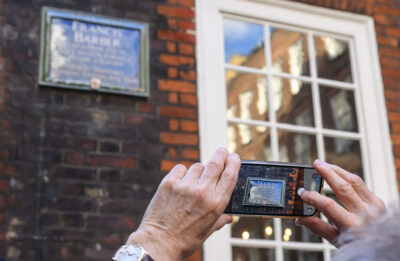
During yesterday’s event, a Blue Plaque honouring Francis Barber was unveiled by Alderman Tim Hailes and Michael Bundock, director of Dr. Johnson’s House Trust and author of The Fortunes of Francis Barber. The plaque, which refers to Barber’s enslavement in Jamaica and subsequent career as a teacher near Lichfield in Staffordshire, was approved under the previous Blue Plaques Scheme.
The event also marked 150 years since the City’s oldest Blue Plaque was unveiled in honour of Dr Johnson at the same historic site, making it an appropriate setting for the launch of the redesigned scheme.
Of the 140 plaques in the Square Mile, most of them commemorate institutions and organisations, such as the Samaritans, Great Synagogue, and Royal College of Physicians, with 32 plaques representing individuals. Following a comprehensive review, the scheme has been redesigned to provide a modern, transparent, and inclusive process with clear guidance, embedded equality, equity, diversity, and inclusion principles, and strong governance.
Other improvements include an advisory panel of experts to assess applications, a new online application form, and a refreshed webpage.
While each plaque will be funded primarily by applicants or their sponsors, a new annual City of London Corporation funding pot will support at least one outstanding application each year that is unable to self-fund.
Successful applicants will be supported with comprehensive guidance to commission and install approved plaques, and to bring them to fruition.
Brendan Barns, Chair of the City of London Corporation’s Culture, Heritage, and Libraries Committee, said:
“Our Blue Plaques Scheme makes a very welcome return and highlights the City of London Corporation’s renewed commitment to commemorating remarkable people, places, and institutions that have shaped the Square Mile.
“It is our hope that the redesigned scheme will attract thoughtful and persuasively written applications from a wide range of backgrounds, all of them reminding us that, behind every Blue Plaque is a story worth telling.”
Celine Luppo McDaid, The Hyde Director of Dr Johnson’s House, said:
“We are thrilled to celebrate the remarkable life of Francis Barber with this Blue Plaque. Enslaved on a Jamaican plantation, Barber came to London and, in this house, he learned to read and write, going on to become the first Black teacher in British history. His story is central to our commitment to bringing long-overlooked lives into the present day.
“As the House of Words, Dr Johnson’s House explores and represents the experiences and legacies of Francis Barber and the extraordinary people who were living here in the middle of the 18th century.
“By engaging with issues such as friendship, grief, gender, identity, slavery, and mental health, the lives of those who went before us resonate with our 21st -century audiences.”
Lady Lucy French, CEO of Fleet Street Quarter Business Improvement District
(BID) said:
“Fleet Street Quarter has always been a place where stories are created and brought to life, so it feels particularly fitting to launch the City of London Corporation’s redesigned Blue Plaques Scheme at the historic Dr Johnson’s House with a plaque commemorating Francis Barber’s life.
“The BID is proud to be working with our partners to create more opportunities for people to discover this fascinating part of the City, and to ensure that its rich cultural legacy continues to inspire in the years to come.”
The City of London Corporation is one of the largest funders of heritage and cultural activities in the UK and invests over £145m every year. It manages a range of world- class cultural and heritage institutions, including the Barbican Centre, Tower Bridge, Guildhall School of Music & Drama, Guildhall Library, Guildhall Art Gallery, The London Archives, and Keats House.
The City Corporation also supports the London Symphony Orchestra and London
Museum, which will open on 28 November.